LFHS Mold: The District Wasn’t Upfront With Parents


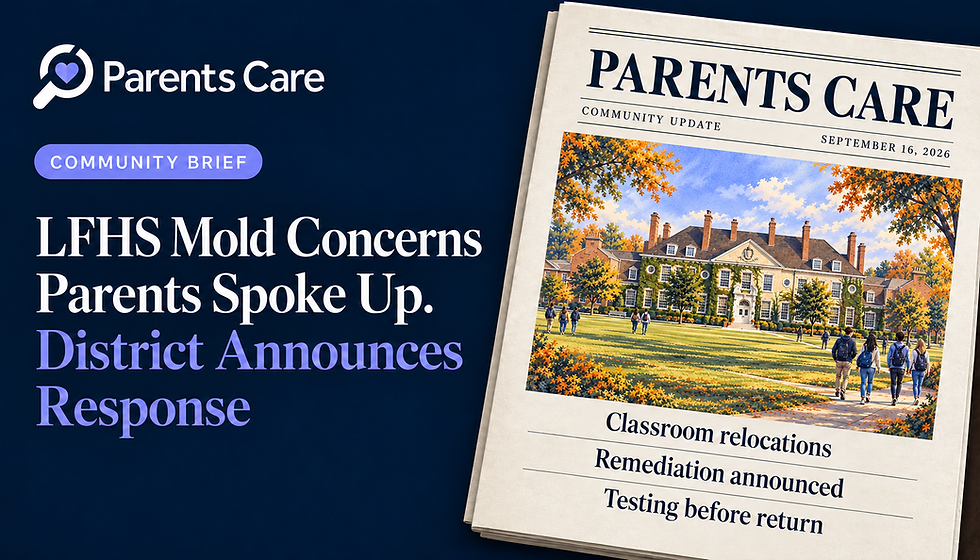
Cover includes a parent-supplied LFHS classroom photo from our September 17 report.
Parents raised mold concerns at Lake Forest High School. Records document a classroom’s early return, building failures and costs still needing a public accounting.
At Lake Forest High School’s September 9 open house, a parent identified apparent mold on ceiling panels. A parent account later shared with Parents Care described classes being moved for cleaning, then returning to the room.
On September 15, after receiving photographs and concerns through emails and Facebook messages, Parents Care contacted board leadership and Superintendent Montgomery. The following day, Principal Erin Lenart told families that preliminary testing had found elevated mold spores and affected spaces were closing for mitigation.
Records later obtained through FOIA documented an early classroom return and specific building failures that families deserved to have clearly explained. Parents Care’s view is straightforward: the district was not upfront with parents about the full story.
Students returned before results arrived
The district’s October 9 account acknowledges that a classroom was cleaned, visually assessed and returned to use while test results were still pending. Staff cited the consultant’s reassuring inspection. The district says it closed the room when results showed elevated mold spores.
An internal September 12 email from facilities director Daniel Mortensen captured the choice: “So you can wait for results or go back in Monday. Your call.”
Who authorized that decision, what advice supported it, and why were results not required first? Parents deserve a clear account of the judgment officials made about their children’s safety.
What the investigation found
Families were told that unusual heat and humidity had strained an aging HVAC system, with renovations already planned. September 16’s update mentioned pipe-insulation work, but did not plainly explain the specific failures the consultant documented.
The report found that ventilators in rooms 204 and 206 defaulted to 100% outside air, bringing humid air inside. Pipes above classroom ceilings lacked insulation, and corridor valves installed during construction had not been reinsulated. Condensation from the uninsulated valves damaged ceiling panels.
The report dates valve insulation and ventilation adjustments to September 14–15, before the September 16 parent update. Weather and age may also have contributed. The report does not establish when those valves were installed or whether these failures involved the current renovation project. That connection needs to be investigated.
The highest initial indoor spore count was measured in a second-floor hallway:
The lab reported 100,000 Penicillium/Aspergillus-type spores and 30,000 Cladosporium spores per cubic meter. The first category groups similar-looking spores; it does not identify exact species.
The EPA says mold exposure may cause allergy symptoms such as sneezing, runny nose, irritated eyes or a rash. It may also trigger asthma attacks in people with asthma who are allergic to mold.
This historical count does not establish anyone’s individual health risk or prove illness. After cleanup, follow-up tests supported reopening the cleaned areas.
Who is responsible—and who pays?
The records include a $24,150 consulting invoice and a form listing $22,650.10 for cleanup work. They do not establish what taxpayers actually paid, whether the amounts overlap or the full cost. A complete accounting should identify who paid the bills.
If faulty work contributed, the district should determine whether correction or reimbursement is available under its contracts, warranties or insurance—and disclose what it has pursued. Taxpayers should not automatically bear costs that a responsible party may be obligated to cover.
The district acknowledged the early return and linked its report in the October 9 Friday Fanout newsletter. That was appropriate. But parents should not have to find key acknowledgments in a newsletter or rely on Parents Care to piece together the story. Setbacks deserve the same direct, prominent explanation as the progress celebrated in Under the Hard Hat.
Superintendent Montgomery and the District 115 Board should answer four questions publicly:
Who authorized the classroom’s early return, what advice supported it, and why were results not required first?
Which construction project included the affected valves, and did the current renovations contribute to the moisture problems?
Who was responsible for the ventilation settings, restoring insulation, and inspecting and accepting that work?
What was billed and paid, by whom, and what contractor correction, warranty or insurance recovery has the district pursued where applicable?
Children deserve safe classrooms. Teachers deserve a healthy workplace. Taxpayers deserve accountability. Those answers should come directly from District 115 in one clear public accounting.
Read the records
Subscribe to Parents Care for updates on student safety, transparency and taxpayer accountability.